


Data Governance Framework: A Guide for Enterprise Data Management
Enterprise data loses trust fast when teams use different definitions, access rules, ownership models, and quality standards. A data governance framework gives your organization a shared structure for deciding who controls data, how it moves, and which rules apply. This MOR Software guide will cover the main components, reference models, implementation steps, measurement methods, common problems, and AI governance requirements enterprises need to plan for.
Key Takeaways
- A governance model connects business goals with ownership, policies, security controls, data quality, technology, and measurable accountability.
- Enterprises should adapt governance to their data domains, regulations, operating structure, and technical environment rather than copy one template.
- Governance must extend into cloud platforms, analytics pipelines, AI models, vector databases, and agent-based systems as enterprise data use expands.
What Is a Data Governance Framework?
A data governance framework is a documented structure that defines how an organization manages, controls, protects, and makes decisions about enterprise data. It turns governance principles into rules that business teams, IT teams, data owners, and data stewards can follow during daily operations.
Organizations use different data governance frameworks, but most address several common questions: Who owns a dataset? Who may access it? Which quality standards apply? How are policy breaches handled? What happens when a definition, permission, or data value changes?
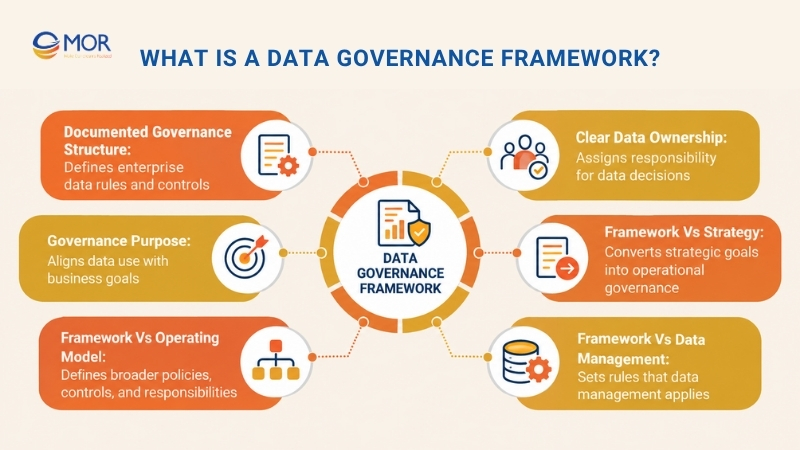
- Purpose: Governance connects business goals with policies, ownership, workflows, technical controls, and measurement. The aim is consistent and trusted data use across the company.
- Framework vs. strategy: A data governance strategy describes the outcomes your organization wants. The governance structure defines the roles, processes, controls, and decision paths needed to reach them.
- Framework vs. operating model: The wider structure covers policies, technology, measurement, and responsibilities. An operating model focuses on how decisions move across central teams, business units, and data domains.
- Framework vs. data management: Governance defines rules and decision rights. Data management applies those rules when teams collect, integrate, store, clean, secure, archive, and delete information.
These distinctions matter during implementation. A company can have strong data management tools and still face unclear ownership or conflicting definitions if governance responsibilities remain vague.
Why Data Governance Frameworks Matter to Enterprises
Trusted data supports reporting, forecasting, customer operations, compliance, analytics, and AI. Weak governance creates the opposite result: teams spend time checking numbers, reconciling reports, tracing ownership, and fixing records that should have been controlled earlier.
The financial cost can become substantial. Gartner reports that poor data quality costs organizations at least $12.9 million per year on average, which explains why data quality must be managed as an operating issue rather than a cleanup task.
An enterprise data governance framework addresses these risks through shared controls:
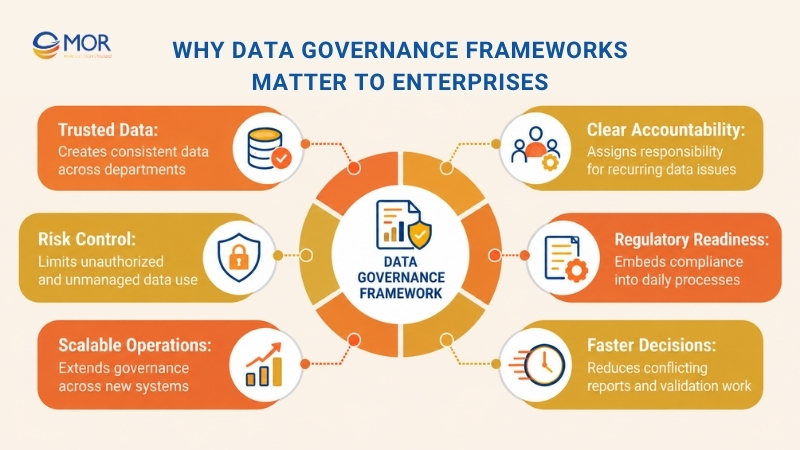
- Trusted data: Common definitions and quality rules make financial, operational, customer, and analytics data easier to use across departments.
- Clear accountability: Named owners and stewards stop recurring data issues from sitting between business teams, IT, security, and compliance.
- Regulatory readiness: Retention, consent, classification, access, and audit rules become part of daily processes rather than documents reviewed only before an audit.
- Faster decisions: Consistent datasets cut the time teams spend comparing conflicting dashboards or checking which source is correct.
- Scalable operations: New applications, business units, cloud systems, and analytics workloads inherit an existing set of governance rules.
- Risk control: Permission management, classification, lineage, and monitoring help limit unauthorized use and unmanaged sensitive information.
Governance also supports growth. A new CRM, data warehouse, customer portal, or AI application can connect to established ownership and policy rules rather than create another isolated data environment.
Core Components of a Data Governance Framework
The right data governance framework components depend on your organization, but effective governance usually connects business ownership, policy, security, data quality, architecture, workflow, and measurement. Treating these areas separately creates gaps between written policy and actual system behavior.
The following areas form the working structure behind most enterprise governance programs.
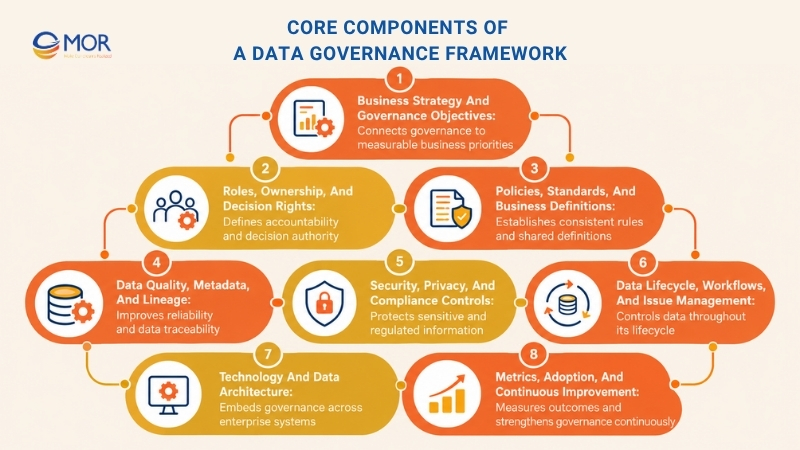
Business Strategy and Governance Objectives
Start with a business reason for governing data. Compliance may drive one program, while another company may focus on financial reporting, customer data, operational analytics, AI readiness, or a large ERP transformation.
Scope also matters. Teams should identify priority data domains, the business decisions that depend on them, major risks, and measurable target outcomes. Governance then becomes tied to operating priorities instead of becoming an isolated documentation project.
A big data governance framework often needs a tighter link between governance goals and platform design because data volumes, distributed processing, diverse sources, and rapid ingestion make manual controls difficult to maintain.
Roles, Ownership, and Decision Rights
Good data governance structures make accountability visible. Most organizations need an executive sponsor, a governance council or similar decision group, data owners, data stewards, technical custodians, security teams, and the people who create or consume data.
The data governance organizational structure should also state decision rights. A steward may correct quality issues, for instance, while the data owner approves definitions or access rules and the governance council resolves cross-domain conflicts.
Define escalation paths early. When sales and finance disagree about the meaning of 'active customer,' everyone should know who makes the final decision and where that definition is recorded.
Policies, Standards, and Business Definitions
Policies convert governance goals into requirements teams can apply. They may cover data access, acceptable use, classification, quality, retention, sharing, naming conventions, privacy, metadata, and disposal.
A data governance policy framework also needs supporting standards. A policy may require accurate customer data, but a working standard defines required fields, validation rules, duplicate thresholds, accepted formats, and responsibility for corrections.
Business glossaries play a related role. Shared definitions stop departments from attaching different meanings to revenue, order status, customer, inventory, churn, or other business terms.
Data Quality, Metadata, and Lineage
Data quality covers accuracy, completeness, consistency, validity, timeliness, and uniqueness. Teams need agreed thresholds for important datasets plus processes for detecting, assigning, correcting, and preventing quality issues.
Metadata explains what a dataset contains and how teams should use it. Lineage traces where data originated, which transformations changed it, and where it moved afterward.
These elements of data governance become especially useful in analytics work. A dashboard number is easier to trust when an analyst can trace it back through transformation logic to an approved source.
MOR Software has also covered data hygiene tools and practices, which become useful when governance teams need repeatable ways to identify duplicates, obsolete records, formatting errors, and incomplete data.
Security, Privacy, and Compliance Controls
Security controls determine which users, applications, vendors, models, or automated agents may access a dataset. Classification rules then apply stricter controls to financial records, personally identifiable information, medical data, credentials, or other sensitive material.
Compliance adds another layer. In its 2025 annual report, the European Data Protection Board reported that national Data Protection Authorities issued €1.15 billion in fines during the year. Governance teams need traceable consent, retention, transfer, access, and deletion controls when personal data falls under GDPR requirements.
Auditability matters here. Teams should be able to identify who changed a policy, who accessed protected information, when permissions changed, and which systems received regulated data.
Data Lifecycle, Workflows, and Issue Management
Governance applies throughout the lifecycle. Controls begin when data is created or collected and continue through validation, storage, integration, use, sharing, modification, archival, and deletion.
A documented data governance workflow tells teams what happens when something goes wrong. It should cover issue detection, classification, assignment, investigation, correction, approval, escalation, and closure.
Workflow design also prevents governance from relying on email threads or spreadsheets. Ticketing, approval, and monitoring tools can route issues to the right owner and preserve an audit history.
Technology and Data Architecture
Governance technology often includes data catalogs, business glossaries, metadata systems, master data management, data quality platforms, identity and access management, lineage tools, policy engines, monitoring, and workflow systems.
Architecture determines how these controls connect to databases, SaaS applications, ERP platforms, CRM systems, warehouses, lakehouses, cloud services, and analytics applications. Teams planning enterprise big data platforms should include governance requirements in platform architecture rather than attach them after deployment.
A data governance framework for big data may also require automated metadata capture, distributed access controls, lineage across pipelines, and policy checks inside ingestion or transformation jobs. Manual review cannot keep pace with high-volume data movement.
Metrics, Adoption, and Continuous Improvement
Governance teams need evidence that rules are being followed and producing better outcomes. Useful measures include data quality scores, ownership coverage, issue resolution time, access-review completion, policy adoption, catalog coverage, and user participation.
Business measures belong in the same discussion. Better governance may shorten reporting cycles, cut reconciliation work, improve analytics delivery, or lower rework caused by inaccurate records.
Measurement also changes the conversation with executives. Instead of reporting how many policies were written, the governance team can report how data reliability or issue resolution changed after those policies became operational.
Data Governance Framework Examples to Consider
No reference model fits every company. The most useful data governance examples provide structures you can adapt around your industry, regulatory exposure, decision model, existing architecture, and governance maturity.
Framework or model | Primary focus | Governance depth | Best-fit environment | Main strength | Adaptation point |
Data Governance Institute (DGI) | Decision rights, rules, accountability | High | Enterprises building formal governance programs | Strong operating structure | Needs tailoring to internal roles and domains |
DAMA-DMBOK | Broad data management disciplines | Very high | Data-heavy enterprises and mature data teams | Wide coverage across data management | Can be too broad for a narrow first rollout |
COBIT | IT governance, control, risk | High | Regulated or control-heavy organizations | Strong link between IT governance and business goals | Data governance is one part of a wider IT model |
DCAM | Data management capability and maturity | High | Financial services and large enterprises | Strong capability assessment | Requires mature ownership and measurement |
McKinsey model | Domain ownership and business value | Flexible | Enterprises linking governance to analytics or transformation | Business-led governance | Implementation structure must be designed internally |
PwC enterprise model | Governance, risk, ownership, policy | Flexible | Large regulated organizations | Enterprise risk alignment | Requires adaptation to data architecture and operating model |
Model selection should start with business needs rather than brand recognition. An organization with one central data team faces different governance needs from a global group where business units control separate domains.
Real projects show why architecture and governance need to connect. McKinsey’s Caserta practice reports that a commercial real estate data platform paired data engineering with a governance strategy and searchable catalog, contributing to $10 million in revenue growth, about $1.7 million in lower operating expenses, and roughly 2,000% more property data availability.
Many enterprises combine ideas instead of adopting one model word for word. DAMA-DMBOK may guide data management disciplines, DCAM may support maturity assessment, and a domain-based operating model may control day-to-day ownership.
How to Build a Data Governance Framework Step by Step
Implementation works best when governance starts around real business problems. The strongest best practices in data governance connect policies and ownership to the systems, decisions, and teams that already depend on the data.
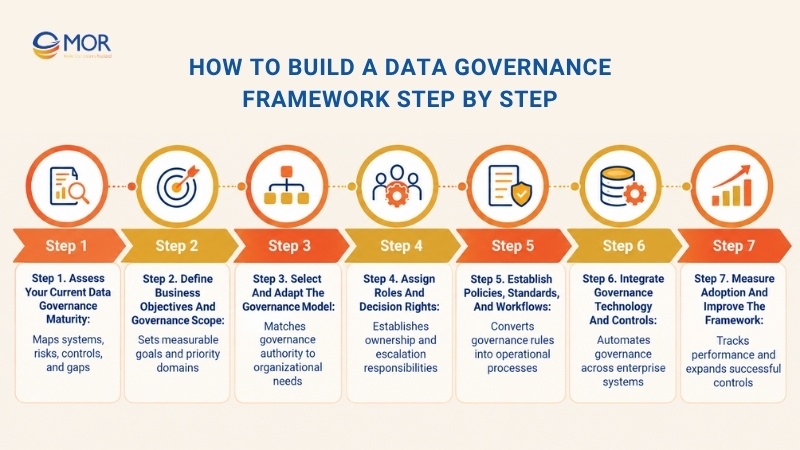
Step 1. Assess Your Current Data Governance Maturity
Start by mapping how data currently moves across the organization. Identify key systems, major data domains, current owners, known quality issues, access controls, regulatory requirements, and existing governance processes.
McKinsey found that respondents to its Global Data Transformation Survey spent an average of 30% of enterprise time on non-value-added tasks because of poor data quality and availability. That type of baseline gives a governance program a business case that leaders can understand.
- Data inventory: Record important datasets, systems, interfaces, reports, and business users.
- Current controls: Review ownership, policies, permissions, validation rules, and monitoring.
- Pain points: Map duplicated records, conflicting definitions, manual reconciliation, access gaps, and recurring incidents.
- Baseline: Capture current quality scores, issue volume, resolution time, and ownership coverage.
Step 2. Define Business Objectives and Governance Scope
Set a clear target before designing committees or buying tools. Governance could support regulatory reporting, customer 360 initiatives, an ERP rollout, financial consolidation, analytics, or AI development.
- Business outcomes: Connect governance work to a measurable operational or risk goal.
- Initial scope: Start with data domains that carry high business value or high risk.
- Success criteria: Set targets for quality, ownership, access, issue handling, or delivery time.
A narrower first phase usually gives teams more useful evidence than a company-wide rollout built around dozens of policies at once.
Step 3. Select and Adapt the Governance Model
Choose how authority should move through your organization. Centralized models give one governance body greater control, decentralized models shift authority toward business units, and federated models combine central standards with domain ownership.
- Decision structure: Match authority to your company size, operating model, and regulatory needs.
- Reference model: Use DGI, DAMA-DMBOK, DCAM, COBIT, or another model where it adds useful structure.
- Adaptation: Adjust terminology, committees, controls, and workflows around existing business processes.
The best model is one that people can actually use. A technically detailed model still fails when teams cannot tell who approves a definition or resolves a data issue.
Step 4. Assign Roles and Decision Rights
Assign ownership at the data-domain level. Customer, product, supplier, employee, finance, asset, or transaction domains may each require different business owners and stewards.
- Executive sponsor: Provides authority, funding, and cross-department support.
- Governance council: Makes policy decisions and handles disputes that cross domains.
- Data owners: Approve standards, access rules, and business definitions for assigned domains.
- Data stewards: Handle quality, metadata, definitions, and day-to-day governance work.
- Escalation paths: State who decides when teams cannot resolve a conflict.
Write these responsibilities into role descriptions or governance documents. Verbal ownership disappears quickly when priorities change.
Step 5. Establish Policies, Standards, and Workflows
Create policy only where teams need a shared rule. Then translate each policy into standards and operating steps that systems and users can follow.
- Data standards: Define naming, format, validation, completeness, and quality thresholds.
- Access policies: Define role-based access, approval rules, and periodic reviews.
- Lifecycle controls: Set retention, archival, disposal, and deletion requirements.
- Issue workflows: Define detection, ownership, investigation, correction, escalation, and closure.
Avoid writing policies that cannot be tested. A rule like 'maintain high-quality customer data' gives teams little direction. A measurable completeness threshold and assigned owner create something operational.
Step 6. Integrate Governance Technology and Controls
Technology should enforce or automate decisions already defined through governance. Start with systems that support metadata, lineage, access, quality validation, policy monitoring, master data, or issue management.
- Metadata: Build searchable catalogs, glossaries, ownership records, and lineage.
- Data quality: Automate validation and monitoring for high-value fields.
- Security: Connect IAM, classification, privacy controls, audit logging, and governance policies.
- Integration: Apply controls across ERP, CRM, SaaS, cloud, analytics, and AI workflows.
Cloud environments need the same attention. MOR Software’s guide to cloud data governance best practices covers controls that become relevant when data moves across cloud applications and services.
Integration also determines whether governance survives outside one platform. Teams working on data integration in business intelligence need shared definitions and lineage across source systems, ETL or ELT processes, warehouses, and reporting tools.
Step 7. Measure Adoption and Improve the Framework
Measure actual behavior, not the number of governance documents created. A policy has little value when teams bypass it or cannot find the approved definition.
- Governance KPIs: Track ownership coverage, data quality, issue closure, policy compliance, and access reviews.
- Training: Teach each role the decisions and tasks it owns.
- Review cycles: Revisit standards, workflows, responsibilities, and tooling at scheduled intervals.
- Expansion: Extend successful controls into new data domains after the first scope proves workable.
Business growth will change governance requirements. Acquisitions, new cloud platforms, new regulations, AI systems, and regional expansion can introduce data sources and responsibilities that were not part of the initial design.
Data Governance Framework Template: What to Document
A practical template turns governance decisions into one reference that business and technical teams can use. The aim is to capture who decides, what is controlled, how controls work, and when teams review them.
Framework element | What to define | Accountable owner | Example documentation | Review frequency |
Business objectives | Outcomes and business priorities | Executive sponsor | Governance charter | Annual |
Scope | Systems, domains, regions, and business units | Governance council | Scope register | Quarterly |
Data domains | Main enterprise data groups | Data owners | Domain map | Quarterly |
Operating model | Centralized, decentralized, or federated structure | Governance council | Operating model document | Annual |
Roles | Owners, stewards, custodians, users | Business and data leaders | RACI matrix | Quarterly |
Decision rights | Approval and escalation authority | Governance council | Decision-rights matrix | Annual |
Policies | Access, use, retention, quality, privacy | Policy owners | Policy repository | Annual |
Quality requirements | Metrics, thresholds, validation | Data owners | Quality rule catalog | Monthly |
Security controls | Classification and access rules | Security team | Access-control matrix | Quarterly |
Metadata and lineage | Definitions, sources, transformations | Data stewards | Data catalog | Continuous |
Supporting technology | Governance and data platforms | IT/data architecture | Technology map | Semiannual |
KPIs | Adoption and business measures | Governance lead | Governance scorecard | Monthly |
Escalation | Issue routing and decision path | Governance council | Issue workflow | Annual |
Keep this template connected to real systems. If the documented owner, policy, or quality rule differs from what users see in the catalog, IAM platform, CRM, or warehouse, trust in governance falls quickly.
How to Measure Data Governance Maturity and Success
Maturity describes how consistently governance works across the organization. It should reflect real ownership, policy adoption, technology use, measurement, and business participation.
Maturity level | Governance characteristics | Ownership status | Policy adoption | Technology enablement | Measurement capability | Priority |
Level 1: Ad hoc | Teams manage data independently | Unclear | Inconsistent | Manual | Minimal | Map current state |
Level 2: Defined | Policies and roles are documented | Assigned for priority areas | Partial | Basic tools | Initial KPIs | Put processes into use |
Level 3: Operational | Governance runs through repeatable workflows | Active | Broad | Integrated tools | Regular reporting | Expand coverage |
Level 4: Measured | Decisions use governance metrics | Clear across domains | High | Automated monitoring | Business and data KPIs | Improve performance |
Level 5: Optimized | Governance changes with business and risk needs | Embedded | Enterprise-wide | High automation | Predictive and outcome-based | Continuous refinement |
Track measures that expose real operating performance. Ownership coverage, data quality scores, policy compliance, access-review completion, catalog coverage, and mean issue resolution time provide stronger evidence than policy counts.
Add business measures where possible. Reporting rework, analytics delivery time, reconciliation effort, customer-data errors, or audit findings can connect governance progress to business outcomes.
Common Data Governance Framework Challenges and Fixes
Governance failures often come from organization and execution rather than the written model itself. The following problems appear when policies, ownership, technology, and business priorities drift apart.
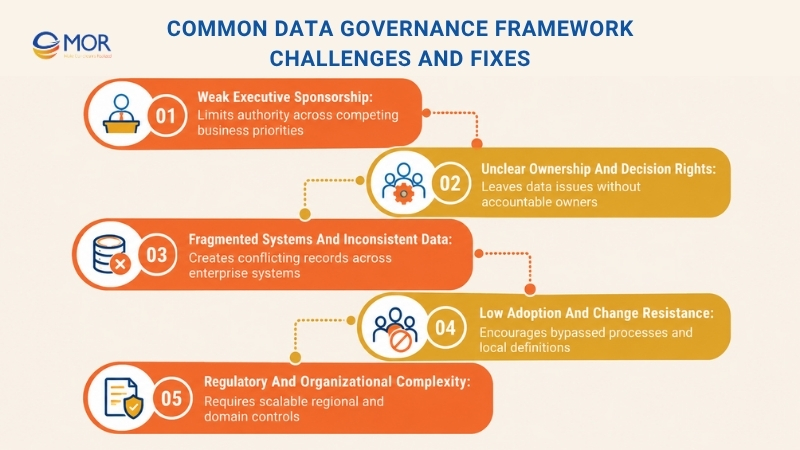
Weak Executive Sponsorship
Data governance crosses department boundaries, so teams need authority to resolve disputes about ownership, access, definitions, and budget. A program led only by a technical team can struggle when business units have competing priorities.
- Problem: Governance becomes an IT responsibility with limited business ownership.
- Fix: Give an executive sponsor authority over priorities, funding, and unresolved cross-functional decisions.
Tie governance targets to existing programs. ERP modernization, analytics, compliance, CRM consolidation, and AI programs already depend on reliable data and provide a clear reason for executive involvement.
Unclear Ownership and Decision Rights
A dataset may move through several systems and teams. Without explicit decision rights, everyone touches the data but nobody owns the final quality standard or business definition.
- Problem: Issues move between IT, operations, security, finance, or sales without resolution.
- Fix: Assign owners by domain and document what each owner, steward, custodian, and council may decide.
Ownership should remain visible in catalogs and governance records. Staff changes then become an update to a defined role rather than a loss of institutional knowledge.
Fragmented Systems and Inconsistent Data
ERP, CRM, SaaS, cloud databases, legacy systems, and spreadsheets often store overlapping information. Customer, product, supplier, or finance records then develop different values and definitions.
- Problem: Teams spend time matching records and reconciling reports.
- Fix: Map authoritative sources, define master data, connect metadata, establish quality rules, and track lineage across integrations.
Integration projects should carry governance rules with the data. Otherwise, a clean source system can still feed inconsistent mappings into downstream analytics or operational applications.
Low Adoption and Change Resistance
Employees often see governance as extra approval work when the value is not visible. Long policy documents make this worse when users cannot connect them to the task they are performing.
- Problem: Teams bypass processes, use unofficial spreadsheets, or create local definitions.
- Fix: Put governance inside existing tools and workflows, then train people around the decisions they actually make.
Small wins matter here. Fixing one recurring reporting issue can demonstrate the value of ownership and common definitions better than another governance presentation.
Regulatory and Organizational Complexity
Global enterprises manage different privacy rules, internal policies, business units, systems, and risk levels. One rigid process may create excessive control in low-risk areas and too little control where sensitive data is involved.
- Problem: Governance becomes hard to scale across regions and business domains.
- Fix: Keep common enterprise principles, then allow domain or regional rules where regulation and operating requirements differ.
Federated governance often fits this situation. Central teams define shared standards while business or regional owners manage approved variations within their scope.
How AI Changes Data Governance Framework Requirements
AI expands the amount and type of information governance teams must track. Traditional controls focus heavily on databases, warehouses, reports, and business applications, but AI systems also use documents, chats, embeddings, vector stores, prompts, model outputs, external datasets, and agent-accessible tools.
An AI data governance framework should cover the data feeding models and the information those systems create. IBM’s 2026 Cost of a Data Breach research found that one in four malicious breaches were AI-enabled, and these incidents cost an average of $6 million.
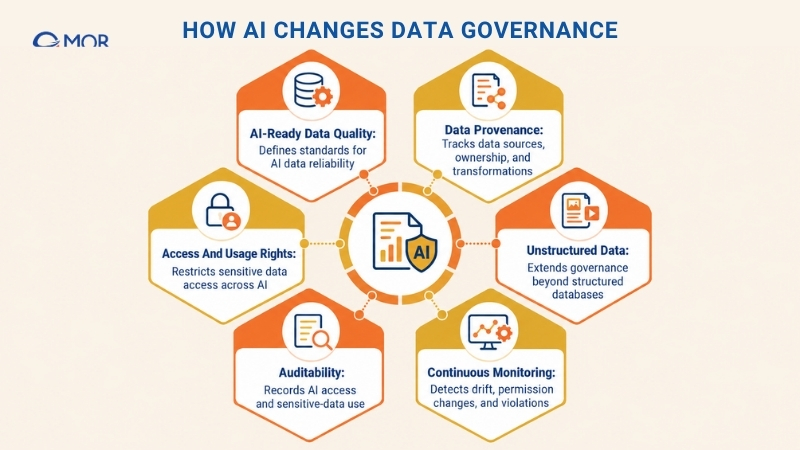
- AI-ready data quality: Define quality requirements for training, retrieval, grounding, evaluation, and operational datasets.
- Data provenance: Record source, ownership, licensing, transformation history, and movement into AI systems.
- Access and usage rights: Limit which models, agents, employees, or external services may retrieve sensitive data.
- Unstructured data: Extend classification and retention controls into documents, conversations, files, knowledge bases, and vector databases.
- Auditability: Record model or agent access to data, major transformations, policy decisions, and sensitive-data use.
- Continuous monitoring: Track permission changes, source changes, data-quality drift, and policy violations after deployment.
Teams selecting AI governance tools should evaluate how those tools connect with existing data catalogs, IAM controls, model registries, monitoring systems, and enterprise workflows. Separate AI governance and data governance systems can recreate the same silos governance teams are trying to remove.
Strengthen Data Governance Framework With MOR Software
Governance plans often fail at the technical execution layer. Policies may exist, yet ERP systems, CRM platforms, internal applications, data pipelines, and access workflows still operate separately.
MOR Software supports enterprises that need software engineering and system integration to turn governance requirements into working applications and processes. Its service materials include project-based development, Offshore Development Center delivery, DevOps and QA support, plus information security and quality management practices.
- Build systems around governance requirements: We develop software around defined business processes, data flows, permissions, validation logic, reporting needs, and internal workflows. This approach fits companies whose governance requirements cannot be handled through standard software configuration alone.
- Connect fragmented enterprise systems: Integration work can connect applications that hold overlapping customer, operational, financial, or internal data. MOR Software supports system development alongside web, mobile, and enterprise software services, which gives teams one engineering partner for connected workflows rather than isolated applications.
- Extend governance into Salesforce operations: MOR Software provides Salesforce consulting, implementation, development, integration, management, and maintenance. We are also listed as a Salesforce Global Partner in our service materials.
- Apply QA and delivery controls: Governance-related systems need reliable validation, security testing, performance checks, and controlled releases. MOR Software’s services include DevOps and QA support, functional testing, performance testing, security testing, and usability testing.
- Match delivery to enterprise team needs: Project-based development fits defined software initiatives, while the ODC model supports organizations that need a dedicated external engineering team. MOR Software also works across finance and banking, manufacturing, human resource management, and food and beverage, among other sectors listed in its service portfolio.
MOR Software’s Salesforce portfolio also lists Salesforce and Pardot integration, custom Salesforce development, and a high-volume ticket management system among its success stories. These projects provide relevant proof for companies dealing with CRM integration, workflow control, and large operational data volumes.
MOR Software is a suitable fit when your governance roadmap requires custom applications, system integration, Salesforce development, QA support, or an external engineering team to put technical controls into production. Contact us to discuss your data systems, current governance gaps, and the delivery model that fits your project.
Conclusion
A data governance framework works when ownership, policies, workflows, technology, security controls, and measurement become part of daily operations. Keep the structure connected to new data sources, regulations, cloud systems, business priorities, and AI use cases as your organization changes. MOR Software can support the engineering and integration work behind that plan. Contact us to discuss your systems, governance requirements, and implementation needs.
"Evolution is not a destination, it is a disciplined journey of innovation."
Phung Van Tu


CEO MOR AI
MOR SOFTWARE
Frequently Asked Questions (FAQs)
What is a data governance framework?
It is an operating structure that defines how an organization owns, manages, protects, controls, and measures its data. It normally connects business goals with roles, policies, standards, data quality, security, technical systems, and governance metrics.
The structure also defines who makes decisions when teams disagree about data definitions, quality requirements, access, or use.
What are the main components of a data governance framework?
Common components include business objectives, governance roles, decision rights, policies, standards, data quality, metadata, lineage, security, privacy, lifecycle processes, architecture, technology, and performance measures.
The exact mix depends on industry, company size, regulation, architecture, and the types of data the organization manages.
What is the difference between a data governance framework and a data governance strategy?
A strategy defines what the organization wants governance to accomplish. Goals may include trusted reporting, regulatory compliance, better customer records, AI readiness, or stronger ownership.
The operating structure defines how those goals become roles, processes, controls, technology, and metrics. Strategy sets direction, while governance design turns that direction into daily work.
What is the difference between a data governance framework and an operating model?
The wider governance structure covers policy, ownership, technology, data quality, security, measurement, and business alignment. An operating model concentrates on how governance decisions are organized and executed.
For example, a company may use a federated operating model where central teams set enterprise standards while domain owners manage implementation in finance, customer, product, or supplier data.
What types of data governance frameworks are commonly used?
Organizations often reference DAMA-DMBOK, DGI, COBIT, DCAM, McKinsey’s domain-based model, and enterprise governance approaches published by major consulting firms.
Companies also choose centralized, decentralized, or federated operating structures. Many enterprises combine ideas from several models rather than copy one model exactly.
How do you build a data governance framework?
Start with the current state of your data, business problems, regulatory obligations, systems, ownership, and quality issues. Define the scope and desired outcomes before selecting roles, policies, decision rights, workflows, and tools.
Then put governance into daily systems and processes. Track adoption and business measures so teams can expand the model based on evidence.
Who is responsible for data governance in an organization?
Responsibility is shared across several roles. Executive sponsors provide authority, governance councils handle cross-domain decisions, data owners remain accountable for domains, and data stewards manage day-to-day definitions and quality.
IT, security, privacy, data engineering, application teams, and business users also take part. Good governance states where each responsibility starts and ends.
How do you measure whether a data governance framework is working?
Track operational measures like data quality scores, percentage of priority datasets with owners, policy compliance, issue resolution time, catalog coverage, and access-review completion.
Add business measures where possible. Shorter reconciliation time, fewer reporting errors, faster analytics delivery, fewer audit findings, or lower manual cleanup work can connect governance activity to business performance.
How does a data governance framework support AI and generative AI?
Governance defines which data AI systems may access, where that information came from, who owns it, how sensitive information is classified, and which quality standards apply.
Generative AI also brings unstructured sources, vector stores, prompts, retrieved documents, model outputs, and agents into scope. Governance teams need controls that follow this information throughout the AI lifecycle.
How often should a data governance framework be reviewed and updated?
Review major governance policies and operating structures at least on a planned annual cycle, then review high-change areas more often. Access rights, data quality metrics, governance issues, and regulatory changes often need monthly or quarterly attention.
Do not wait for the annual review when your organization introduces a new data platform, acquisition, regulatory requirement, AI system, or major application. Those events can change ownership, risk, and data movement immediately.
Share


Make Our-Dreams Realized


© 2023 . MOR Software. All Rights Reserved
Sitemap
Privacy Policy
Terms of Use

Rate this article
0
over 5.0 based on 0 reviews
Your rating on this news:
Name
*Email
*Write your comment
*Send your comment
1