


Top Agentic AI Use Cases in Manufacturing for 2026 Business
Equipment downtime, quality defects, and production delays often start with problems that factory systems detect but can't resolve on their own. Agentic AI helps close this gap by coordinating decisions and actions across connected systems. According to Rockwell Automation's 2025 report, 95% of surveyed manufacturers have invested or plan to invest in AI technologies within five years. In this guide, MOR Software will explore 12 agentic AI use cases in manufacturing, their business value, and what successful deployment requires.
Key Takeaways
- Agentic AI goes beyond generating predictions and recommendations. It can plan tasks, use enterprise systems, and coordinate approved actions across manufacturing workflows.
- The strongest use cases address measurable factory problems, including unplanned downtime, quality defects, material shortages, and production delays.
- Successful deployment depends on reliable operational data, ERP and MES integration, clear decision limits, and performance tracking.
What Makes Agentic AI Different in Manufacturing?
Agentic AI refers to AI systems that can interpret operational data, plan a sequence of tasks, access connected tools, and execute approved actions toward a defined goal. In manufacturing, these systems coordinate work across Manufacturing Execution Systems (MES), Enterprise Resource Planning (ERP), maintenance platforms, and quality systems.
The main difference lies in how each technology handles decisions and execution.
Technology | Primary Capability | Manufacturing Example | Decision Authority |
Traditional automation | Executes predefined rules and instructions | Stops a conveyor when a sensor detects an obstruction | Fixed, rule-based |
Predictive AI | Identifies patterns and forecasts outcomes | Predicts a machine failure based on vibration data | Provides predictions |
Generative AI | Creates content, explanations, and recommendations | Summarizes maintenance records or drafts troubleshooting instructions | Advisory |
Agentic AI | Plans tasks and coordinates actions across systems | Checks equipment health, verifies spare parts, and prepares a maintenance work order | Acts within approved limits |
Traditional AI in manufacturing use cases often focus on individual tasks, including fault prediction or visual inspection. Agentic AI extends these capabilities into connected workflows.
Consider a machine showing abnormal vibration. Predictive AI flags the issue, and generative AI explains the likely cause. An AI agent can check the maintenance schedule, verify spare-part availability, and prepare a work order for technician approval.
That distinction also explains agentic AI vs generative AI. Many generative AI in manufacturing use cases produce useful information, but agentic systems can carry approved tasks through to completion.
12 Agentic AI Use Cases in Manufacturing
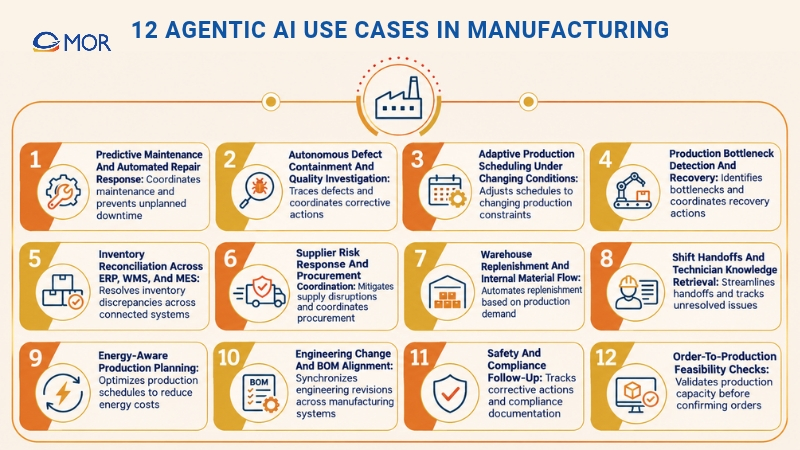
The most practical agentic AI use cases in manufacturing address daily operational problems that require coordination across different teams and systems. These applications build on existing AI in manufacturing capabilities and add the ability to organize follow-up actions.
For manufacturers, the business value comes from shorter response times, fewer manual handoffs, and better control over production decisions.
Agentic AI Use Case | How AI Agents Work | Key Systems | Business Value |
Predictive Maintenance | Detect equipment issues and coordinate repair tasks | SCADA, CMMS, ERP | Less unplanned downtime |
Quality Investigation | Trace defects and prepare corrective actions | QMS, MES, ERP | Lower scrap and rework costs |
Production Scheduling | Adjust schedules based on capacity and disruptions | MES, ERP | Better schedule adherence |
Bottleneck Detection | Identify production constraints and coordinate recovery | MES, SCADA | Higher throughput and OEE |
Inventory Reconciliation | Investigate stock discrepancies across systems | ERP, WMS, MES | Improved inventory accuracy |
Supplier Risk Management | Monitor delivery risks and coordinate procurement responses | ERP, Procurement Systems | Fewer material shortages |
Warehouse Replenishment | Coordinate material movement based on production demand | WMS, MES | Fewer material-related delays |
Shift Handoffs | Consolidate production records and assign follow-up tasks | MES, CMMS, QMS | Faster shift transitions |
Energy-Aware Planning | Recommend production schedules based on energy demand | EMS, MES, ERP | Lower energy costs |
Engineering Change Management | Track BOM revisions and coordinate engineering updates | PLM, ERP, MES | Fewer documentation errors |
Safety and Compliance | Monitor compliance tasks and track corrective actions | EHS, QMS, CMMS | Better audit readiness |
Order Feasibility Checks | Verify capacity, materials, and delivery commitments | ERP, MES | More reliable order fulfillment |
Predictive Maintenance and Automated Repair Response
Unexpected equipment failures can interrupt production, delay orders, and increase maintenance costs. Predictive maintenance systems identify warning signs, but maintenance teams still need to decide when to intervene, who should handle the repair, and which parts are available.
An AI agent can coordinate these tasks through connected systems. It monitors equipment data, checks historical failure patterns, reviews technician availability, and prepares work orders in the Computerized Maintenance Management System (CMMS).
For example, a packaging machine starts showing unusual vibration during a production run. The agent identifies a suitable maintenance window, checks replacement-bearing inventory in ERP, and sends the proposed repair plan for approval.
This makes predictive maintenance one of the more practical agentic AI use cases in manufacturing when sensor data and maintenance records are reliable.
Manufacturers can measure results through unplanned downtime, Mean Time to Repair (MTTR), and Mean Time Between Failures (MTBF). The agent should also track whether its recommended actions lead to confirmed repairs.
Autonomous Defect Containment and Quality Investigation
A vision system can detect a defective product within seconds. Finding the cause and preventing more defective units from reaching customers usually requires a broader investigation.
Agentic AI connects computer vision results with production records, equipment settings, material batches, and quality history. When the system identifies a defect pattern, it can open an investigation in the Quality Management System (QMS), trace affected batches, and prepare containment recommendations.
For example, an automotive component manufacturer detects unusual surface defects after a material change. An agent compares the defect timeline with supplier deliveries and machine settings, then prepares a corrective-action report for the quality team.
Real manufacturing results show the value of connected AI systems. In January 2026, the World Economic Forum reported that ACG Packaging Materials' Shirwal facility cut defects by 71% after deploying more than 30 digital applications involving IIoT, machine learning, generative AI, and digital twins. This result reflects the broader technology program, rather than agentic AI alone.
Key metrics include first-pass yield, scrap rate, defect containment time, and investigation closure time. Decisions involving product release or major process changes should remain subject to authorized quality approval.
Adaptive Production Scheduling Under Changing Conditions
Production schedules rarely stay unchanged throughout a shift. Machine failures, late deliveries, urgent orders, and labor shortages can force planners to reorganize work at short notice.
Agentic AI evaluates these changes using MES, ERP, available capacity, and production constraints. It can compare scheduling options, identify affected orders, and prepare updated schedules for approval.
Consider a factory producing several product variants on shared equipment. When a critical machine becomes unavailable, the agent checks which orders can move to another line without violating material, tooling, or labor requirements.
It can then notify planners, reserve eligible capacity, and update approved scheduling records. This extends manufacturing resource planning into more responsive daily operations.
Among agentic AI use cases in manufacturing, adaptive scheduling is valuable for plants managing frequent changes and complex production sequences. Schedule adherence, throughput, changeover time, and production lead time are useful measures of success. Shorter delays matter only when the revised plan still meets quality and delivery requirements.
Production Bottleneck Detection and Recovery
A production line can lose capacity through small interruptions that receive little attention individually. Repeated micro-stops, rising cycle times, and equipment imbalances can gradually lower overall output.
AI agents monitor production events and compare current line performance with operating targets. They investigate possible causes, identify the responsible workstations, and coordinate recovery tasks.
For instance, an assembly line experiences slower output after a change in product mix. The agent compares station cycle times, identifies the growing queue, and checks whether staffing or material delivery is contributing to the delay.
It can then alert the shift supervisor, prepare a maintenance request, or recommend a permitted scheduling adjustment. Following an intervention, the system checks whether throughput has recovered.
Manufacturers can track Overall Equipment Effectiveness (OEE), bottleneck resolution time, lost production minutes, and units produced per hour. These metrics help distinguish useful interventions from unnecessary alerts.
The goal is faster problem resolution without allowing an AI agent to override machine safeguards or make unauthorized process changes.
Inventory Reconciliation Across ERP, WMS, and MES
Inventory discrepancies create problems when warehouse records and production-floor consumption don't match. A component may appear available in ERP even though the actual quantity is insufficient for the next production order.
Agentic AI compares inventory data across ERP, Warehouse Management Systems (WMS), and MES. It identifies mismatches, investigates possible causes, and prepares correction requests for authorized review.
For example, a manufacturer records 500 components in its warehouse system, but production records indicate higher consumption than expected. The agent checks recent material issues, scrap reports, and pending transactions to identify the likely source.
It can request a physical count or prepare the missing inventory adjustment. This extends AI in inventory management beyond stock forecasting and automated alerts.
Inventory reconciliation is among the agentic AI use cases in manufacturing that can start with limited autonomy and measurable outcomes.
Useful KPIs include inventory accuracy, stockout frequency, reconciliation time, and production interruptions caused by missing materials. Financial inventory changes should follow existing approval controls.
Supplier Risk Response and Procurement Coordination
Late materials can affect production plans long before a shipment reaches the factory. Procurement teams need to monitor supplier commitments, evaluate alternatives, and coordinate changes with production planners.
So, how can agentic AI improve supply chain operations when supplier conditions change?
An agent can monitor delivery schedules, purchase orders, supplier performance, and transportation updates. When a shipment is delayed, it identifies affected production orders and evaluates approved sourcing options.
For example, a component supplier reports a delivery delay that threatens an upcoming production batch. The agent checks alternate inventory, compares approved vendors, and prepares a revised purchasing or scheduling plan.
The interest in greater supply-chain autonomy is growing. KPMG's 2026 US Supply Chain Survey found that 78% of respondents expect at least moderate supply-chain autonomy by 2027.
Supplier coordination is therefore a relevant area among agentic AI use cases in manufacturing, especially for plants dependent on external components.
Performance measures include supplier On-Time In-Full (OTIF) delivery, material shortage frequency, emergency purchasing costs, and expedited freight spending. Purchase-order changes still require the appropriate commercial authority.
Warehouse Replenishment and Internal Material Flow
Production teams can lose valuable time waiting for materials already stored elsewhere in the facility. Fixed replenishment schedules don't always match real consumption or changes in production priorities.
Agentic AI connects warehouse inventory, line-side stock levels, and MES production schedules. It identifies upcoming shortages and coordinates replenishment requests based on actual demand.
Take an electronics factory operating several assembly lines. An agent notices that one line is consuming components faster than planned and checks whether the warehouse has enough stock to sustain the remaining shift.
The agent can create a replenishment request, assign it to an approved material-handling workflow, and verify delivery confirmation. Where automated guided vehicles or warehouse robots are available, tasks can pass through their approved control interfaces.
This is one of the AI use cases in manufacturing industry settings where operational value depends heavily on system connectivity.
Track line-side material availability, replenishment response time, emergency material requests, and interruptions caused by missing components. Physical movement remains under the control of warehouse systems and equipment safety rules.
Shift Handoffs and Technician Knowledge Retrieval
A poorly documented shift handoff can leave incoming teams unaware of unresolved machine faults, quality holds, or maintenance priorities. Important information may be scattered across handwritten logs, messaging tools, and production systems.
AI agents gather approved information from MES, CMMS, QMS, and operator reports. They prepare shift summaries, identify unresolved issues, and assign follow-up tasks to responsible personnel.
For example, a technician reports an intermittent fault shortly before the evening shift ends. The agent retrieves related maintenance records, adds the current fault details, and prepares a handoff note with the recommended troubleshooting procedure.
Many gen AI use cases in manufacturing already support report drafting and technical knowledge retrieval. Agentic workflows go further by tracking whether the assigned follow-up task has been completed.
Manufacturers can monitor handoff preparation time, repeated incidents, unresolved-issue closure rates, and time spent searching for documentation.
The system should retrieve only approved procedures and display their source information. Technicians still need to verify instructions before carrying out maintenance work.
Energy-Aware Production Planning
Energy-intensive equipment can create high operating costs when production activities coincide with peak electricity demand. Yet shifting workloads without checking production constraints can introduce delivery delays and equipment conflicts.
An AI agent evaluates electricity tariffs, energy consumption, production schedules, and machine availability. It identifies opportunities to reschedule suitable activities without disrupting priority orders.
For example, a metal-processing facility operates several high-energy machines. The agent compares the expected energy cost of available operating windows and recommends moving a nonurgent batch to a lower-cost period.
Before proposing the change, it checks equipment capacity, required staffing, delivery deadlines, and changeover requirements.
The decision can then pass to the production planner for approval. This approach also connects naturally with broader manufacturing cost reduction strategies.
Useful metrics include kilowatt-hours per good unit, peak-demand charges, energy cost per batch, and schedule adherence. The agent's goal is to control energy spending without creating new production losses.
Engineering Change and BOM Alignment
Engineering changes often affect drawings, Bills of Materials (BOMs), work instructions, inventory, and production orders. An outdated revision in one system can lead to incorrect material use or expensive rework.
Agentic AI checks engineering changes across Product Lifecycle Management (PLM), ERP, and MES. It identifies mismatched revisions, tracks affected records, and prepares updates for engineering approval.
For example, a supplier substitutes a component in an automotive assembly. The agent identifies which BOMs, manufacturing instructions, and production orders still reference the previous component revision.
It can then prepare a change package, flag affected inventory, and notify the responsible engineering team.
These workflows are relevant to agentic AI use cases in automotive industry operations, where product variants and part revisions require close control.
Manufacturers can measure engineering change cycle time, documentation errors, revision mismatches, and production delays linked to incorrect specifications.
Approval must remain with authorized engineering personnel, especially when a change affects product safety, compliance, or customer requirements.
Safety and Compliance Follow-Up
Manufacturing safety and compliance work involves inspections, training records, corrective actions, and audit evidence. Missed follow-ups can leave findings unresolved or documents incomplete.
AI agents can review inspection schedules, identify overdue tasks, retrieve supporting records, and prepare compliance reports. They can also route unresolved findings to supervisors and track whether corrective actions receive approval.
For example, a plant audit identifies missing maintenance documentation for a regulated production asset. An agent retrieves available records, flags gaps, and assigns the outstanding evidence request to the responsible team.
Similar record-tracking needs appear in agentic AI use cases in aviation industry operations, where maintenance history and approved procedures require careful documentation.
An agent should never bypass safety interlocks, authorize hazardous work independently, or approve a safety-sensitive process change.
Relevant KPIs include overdue corrective actions, inspection completion rates, audit preparation time, and documentation accuracy.
These applications are best suited to administrative coordination and evidence management, leaving physical safety decisions under established industrial controls.
Order-to-Production Feasibility Checks
Accepting customer orders without verifying production capacity can create unrealistic delivery commitments. Sales, planning, procurement, and manufacturing teams often rely on separate systems when checking feasibility.
An AI agent can evaluate available materials, production capacity, labor schedules, and order specifications before a delivery date is confirmed.
Consider a manufacturer receiving an urgent order for a customized product. The agent checks the proposed configuration against the approved BOM, verifies material availability, and reviews open production orders.
It can identify possible capacity conflicts, calculate feasible production windows, and prepare a response for sales and planning teams.
If a requested configuration requires engineering approval or material substitution, the agent flags the order rather than confirming it automatically.
Manufacturers should measure order confirmation time, schedule reliability, order changes after acceptance, and on-time delivery.
The business value comes from making commercial commitments that production teams can realistically fulfill.
How AI Agents Coordinate Actions Across Factory Systems
Agentic AI follows a connected workflow that involves collecting information, evaluating conditions, planning tasks, executing approved actions, and checking results. Unlike earlier AI ML use cases in manufacturing that focus mainly on predictions, these systems coordinate activities across MES, ERP, CMMS, and other factory platforms.
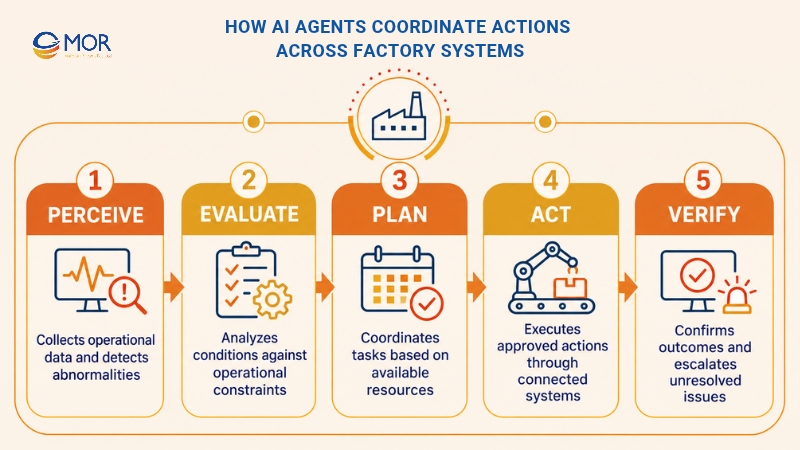
- Perceive: AI agents collect operational data from equipment sensors, MES events, and ERP records to identify changes that require attention. For example, an unusual vibration reading may signal a developing machine fault.
- Evaluate: The agent examines maintenance history, production schedules, and business rules to understand the issue. It checks whether the abnormal reading indicates a genuine equipment problem and identifies constraints that may affect the response.
- Plan: Once the problem is assessed, the agent prepares a sequence of actions based on available resources. A maintenance agent may coordinate with inventory and scheduling agents to check spare parts, technician availability, and suitable repair windows.
- Act: AI agents use approved APIs and enterprise systems to carry out permitted tasks. They may prepare CMMS work orders, notify technicians, or request authorization before making changes that affect production.
- Verify: After an action is completed, the agent reviews updated equipment readings and maintenance records to confirm the outcome. If the problem remains unresolved, it can escalate the issue or recommend further investigation.
For example, abnormal machine vibration can trigger an investigation that leads to a validated maintenance work order. This closed-loop process helps agentic AI use cases in manufacturing move beyond isolated alerts while keeping human approval in place for high-risk decisions.
How to Prioritize Manufacturing Agentic AI Opportunities
Not every manufacturing workflow needs an autonomous AI agent. Some problems can be solved through better reporting, standard automation, or improvements to existing business processes.
The strongest pilot candidates have measurable operational costs, reliable source data, and clear decision boundaries. A factory should also understand which systems the agent must access and who owns the final decision.
Evaluation Factor | High-Priority Indicator | Low-Priority Indicator | Recommended Assessment |
Business value | Frequent losses with measurable costs | Small or unclear operational gains | Estimate the annual cost of the problem |
Workflow complexity | Several manual handoffs across systems | One simple rule-based task | Map the full process and decision points |
Data readiness | Reliable, accessible, current records | Missing or inconsistent data | Audit source systems and data quality |
Integration readiness | Supported APIs and clear ownership | Unsupported legacy interfaces | Assess connection methods and access rights |
Response requirements | Faster coordination can prevent losses | No meaningful response-time pressure | Measure current resolution time |
Operational risk | Actions can be reviewed or reversed | Errors may create unsafe conditions | Define approval and rollback requirements |
A practical assessment starts by mapping the current workflow. Identify the event that triggers action, the systems involved, the decisions people make, and the time lost between steps.
For example, inventory reconciliation may be a better first project than autonomous production scheduling if the plant already has reliable ERP and WMS data.
An equipment maintenance pilot makes more sense when sensor coverage and CMMS records are mature.
When comparing agentic AI use cases in manufacturing, prioritize a narrow process that can produce measurable results within controlled operating limits.
The first deployment should also generate reusable components, including API connections, permissions, event monitoring, and audit records. These foundations can support later projects without forcing the manufacturer to rebuild every integration.
Which KPIs Show ROI From Manufacturing AI Agents?
The value of manufacturing AI agents should be measured through operational improvements, rather than the number of tasks they perform.
Manufacturers already have evidence that connected technologies can support stronger output. According to Deloitte's 2025 Smart Manufacturing and Operations Survey, respondents reported average production-output gains of 10% to 20% after smart manufacturing initiatives. These figures cover broader smart manufacturing investments, so they shouldn't be treated as guaranteed agentic AI results.
Each pilot needs its own baseline and measurement plan.
Business Objective | Key Manufacturing KPI | Measurement Approach | Guardrail Metric |
Improve equipment reliability | MTTR, MTBF, downtime | Compare equipment performance before and after deployment | Incorrect work orders |
Improve production performance | OEE, throughput, cycle time | Track line performance under comparable conditions | Unapproved schedule changes |
Improve product quality | First-pass yield, scrap, rework | Measure defects and corrective-action results | Incorrect defect classifications |
Improve planning accuracy | Schedule adherence, order delays | Compare planned and actual output | Planner overrides |
Improve inventory control | Stock accuracy, stockouts | Audit inventory records and shortages | Incorrect transactions |
Improve procurement | Supplier OTIF, expedited freight cost | Measure deliveries and emergency purchasing | Unauthorized purchase changes |
Return on investment should account for software development, system integration, cloud infrastructure, security testing, monitoring, and ongoing maintenance.
A practical calculation compares the financial value of verified improvements against the total deployment cost over the same period.
For agentic AI use cases in manufacturing, governance metrics also matter. Track false actions, human overrides, failed integrations, and policy violations alongside operational performance.
These measures reveal whether the agent is delivering value within acceptable operating limits.
What Data and System Integrations Do AI Agents Need?
Manufacturing AI agents rely on data shared across Operational Technology (OT) and enterprise Information Technology (IT). Reliable connections allow agents to understand what's happening on the factory floor and coordinate work through approved business systems.
Data quality remains a common barrier. PwC's 2026 Digital Trends in Operations Survey found that 87% of surveyed US operations and supply-chain leaders said poor data quality had affected their ability to gain value from digital initiatives.
The systems below support different parts of agentic workflows.
Manufacturing System | Data Provided | Agentic AI Function | Integration Consideration |
MES | Production orders, work progress, equipment status | Coordinates shop-floor activities | Current production data and permissions |
ERP | Inventory, procurement, costs, orders | Checks business constraints and prepares transactions | APIs, approval rules, audit logs |
SCADA | Equipment signals and process conditions | Detects operational events | Secure OT access and data gateways |
CMMS | Maintenance history, work orders, assets | Coordinates repairs and maintenance tasks | Asset IDs and work-order status |
QMS | Defects, inspections, corrective actions | Supports quality investigations | Traceability and approval controls |
WMS | Warehouse stock, locations, material movements | Coordinates inventory and replenishment | Accurate quantities and location data |
PLM | Engineering changes, product specifications, BOMs | Checks revision alignment | Version control and engineering approval |
Industrial integration also requires common data models and reliable communication methods. OPC UA can support industrial data exchange, while APIs and event streams help agents communicate with enterprise software.
ISA-95 provides a useful reference for defining the relationship between enterprise and manufacturing operations.
For example, a maintenance agent needs a consistent asset identifier across SCADA, CMMS, and ERP. Without matching IDs, timestamps, and equipment records, the agent may connect a fault to the wrong machine or spare part.
Manufacturers can use IoT solutions development to connect equipment data with business applications.
Read-only access is usually the safest starting point. Write-back permissions can be introduced later for approved tasks, supported by audit logs and rollback procedures.
Digital twins and simulation environments can also test proposed scheduling or process changes before they affect physical production.
These requirements determine whether agentic AI use cases in manufacturing can operate reliably beyond a controlled demonstration.
Key Risks and Guardrails for Manufacturing AI Agents
AI agents need defined operating limits when their actions affect production schedules, maintenance activities, inventory records, or quality decisions. Inaccurate information or unauthorized changes can interrupt production and create safety concerns, making risk controls a necessary part of deployment.
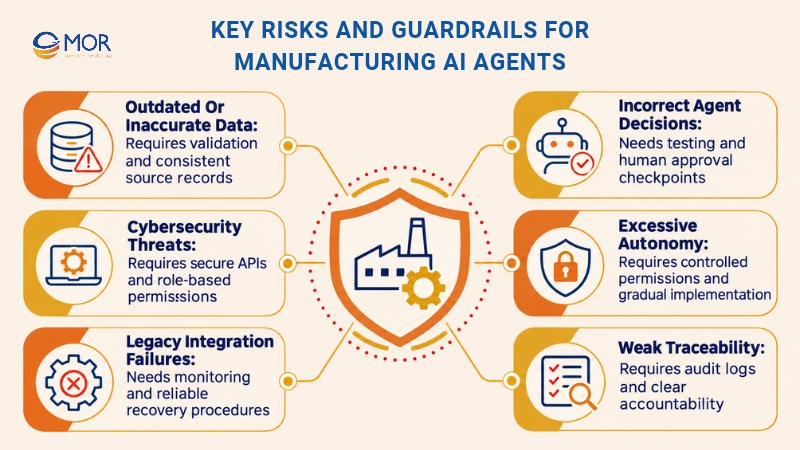
- Outdated or Inaccurate Data: AI agents may make incorrect decisions when equipment readings, inventory records, or maintenance histories are incomplete. Manufacturers should validate source data, check timestamps, and maintain consistent records across connected systems.
- Incorrect Agent Decisions: An agent may recommend unnecessary repairs or unsuitable scheduling changes based on faulty reasoning. Testing, decision thresholds, and human approval checkpoints help prevent these errors from reaching live operations.
- Cybersecurity Threats: Connecting AI agents to ERP, MES, and industrial systems creates additional access points that require protection. Role-based permissions, secure APIs, and network segmentation help limit unauthorized access and system changes.
- Legacy Integration Failures: Older manufacturing systems may lack reliable interfaces or consistent data formats. Integration monitoring, error handling, and recovery procedures help prevent missing transactions and conflicting records.
- Excessive Autonomy: Giving an agent unrestricted control over production or purchasing creates unnecessary operational risk. Manufacturers should introduce autonomy gradually, starting with read-only recommendations before allowing approved transactions and narrowly defined actions. Safety interlocks and deterministic industrial control systems must retain authority over hazardous physical operations.
- Weak Traceability: Teams need to understand why an AI agent recommended or executed a particular action. Audit logs, decision records, and clear ownership make it easier to investigate errors, review compliance, and identify responsible personnel.
Similar governance requirements appear in agentic AI use cases in insurance industry workflows, where access permissions and decision records require careful control. Manufacturing introduces additional concerns because incorrect actions can directly affect physical equipment and production processes.
Every deployment also needs continuous monitoring, escalation rules, and rollback procedures. Operators should know how to review agent decisions, override incorrect recommendations, and disable unsafe actions when necessary.
Bringing Agentic AI to Manufacturing with MOR Software
Deploying AI agents in manufacturing requires software engineering, enterprise integration, reliable data flows, and careful testing.
MOR Software is a Vietnam-based software development company with experience in AI development, IoT, enterprise system integration, and custom software solutions. We help businesses assess technical requirements and build applications that support their operational goals.
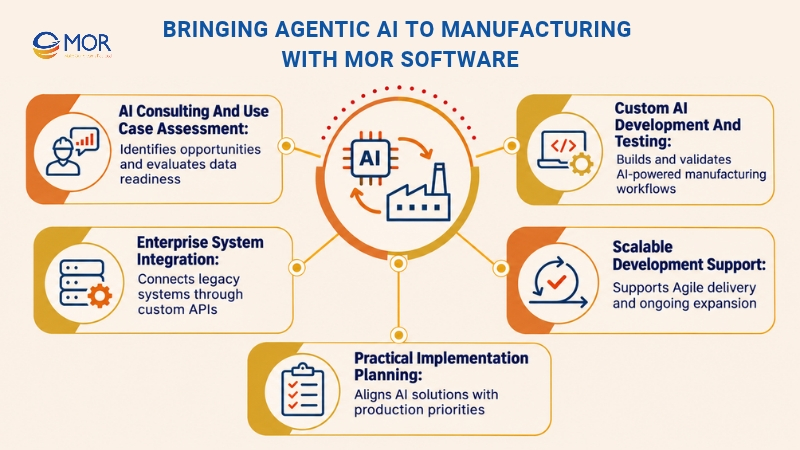
Our capabilities can support manufacturers exploring agentic AI through several areas:
- AI Consulting and Use Case Assessment: We work with your team to identify suitable workflows, assess data readiness, and define measurable business goals before development begins.
- Enterprise System Integration: Our engineers develop APIs, connect legacy software, and build custom applications that support data exchange across business systems.
- Custom AI Development and Testing: We build AI-powered software, connect models with business workflows, and apply quality assurance processes to test reliability and expected behavior.
- Scalable Development Support: Our dedicated development teams support Agile delivery, software maintenance, and the expansion of applications as business requirements grow.
Manufacturers need a practical implementation plan that reflects their existing equipment, software, and production priorities.
Our agentic AI development solution resources can help you assess suitable applications and the engineering work involved.
Contact MOR Software to discuss your manufacturing AI project, review your integration requirements, and identify a suitable starting point.
Conclusion
The 12 agentic AI use cases in manufacturing covered in this guide show how connected AI agents can support maintenance, quality, scheduling, inventory, and production teams. Their business value depends on reliable data, controlled execution, and measurable results. A focused pilot gives manufacturers a practical way to evaluate the technology before expanding it across operations. If you're planning your first project, contact us at MOR Software to discuss your factory requirements and build an implementation plan.
"Evolution is not a destination, it is a disciplined journey of innovation."
Phung Van Tu


CEO MOR AI
MOR SOFTWARE
Frequently Asked Questions (FAQs)
What are the most common agentic AI use cases in manufacturing?
Common applications include predictive maintenance, automated quality investigations, production scheduling, inventory management, and supplier coordination. AI agents connect information across manufacturing systems and organize follow-up tasks. The best starting point depends on the factory's operating problems, available data, and ability to measure results.
How does agentic AI differ from traditional manufacturing AI?
Traditional manufacturing AI commonly predicts faults, classifies defects, or generates recommendations. Agentic AI can plan and coordinate sequences of approved actions across different systems. For example, a predictive model may identify a failing machine, whereas an AI agent can also prepare a repair plan and work order.
Can agentic AI improve predictive maintenance?
Yes. Predictive maintenance identifies equipment conditions that suggest a possible failure. Agentic AI extends the process by checking maintenance history, available spare parts, technician schedules, and production constraints. It can prepare work orders and coordinate approved repairs, helping maintenance teams respond before equipment problems become larger interruptions.
How do manufacturing AI agents improve quality control?
Manufacturing AI agents connect defect detection with root-cause investigation and corrective-action workflows. They can compare inspection results with machine settings, material batches, and production records. When a potential cause is identified, the agent prepares the relevant quality documentation and routes important decisions to authorized employees.
What manufacturing systems must agentic AI integrate with?
The required integrations depend on the workflow. Common systems include ERP for business data, MES for production records, CMMS for maintenance, QMS for quality, WMS for inventory, and SCADA for equipment signals. APIs, event streams, and industrial communication standards support data exchange between these systems.
Can agentic AI work with legacy manufacturing equipment?
Yes, if the required data can be accessed reliably. Manufacturers may use industrial gateways, historians, middleware, or existing SCADA connections to collect information from older machines. Some equipment supports limited data access, so the agent's responsibilities and degree of autonomy must reflect those technical constraints.
What is the best agentic AI use case for a manufacturing pilot?
Choose a workflow with measurable business value, reliable data, manageable decision risk, and clear operational ownership. Inventory reconciliation, maintenance work-order preparation, and shift handoff coordination are possible starting points. The best choice depends on the plant's existing systems rather than a universal ranking of AI applications.
How can manufacturers measure the ROI of agentic AI?
Establish baseline KPIs before deployment, then track changes in downtime, repair time, production output, defects, or inventory accuracy. Compare verified financial gains with development, integration, infrastructure, and maintenance costs. Include false actions, human overrides, and other risk measures to assess the deployment's overall value.
What are the biggest risks of autonomous AI in factories?
Major risks include incorrect decisions, unreliable operational data, cyber threats, and unauthorized system changes. Manufacturers should apply role-based permissions, human approval for high-risk actions, audit trails, and continuous monitoring. Industrial safety systems and trained personnel must retain control over hazardous physical operations.
How long does it take to deploy agentic AI in manufacturing?
Deployment time depends on the chosen workflow, data quality, integration requirements, and testing scope. A limited pilot using existing APIs and reliable data can progress faster than a project involving several legacy factory systems. Manufacturers should base timelines on a technical assessment and validated implementation plan.
Share


Make Our-Dreams Realized


© 2023 . MOR Software. All Rights Reserved
Sitemap
Privacy Policy
Terms of Use

Rate this article
0
over 5.0 based on 0 reviews
Your rating on this news:
Name
*Email
*Write your comment
*Send your comment
1